
Introduction
Noise pollution is one of the most underestimated stressors of modern life. From traffic rumbling through walls to bass thumping from the apartment above, unwanted sound finds its way into our spaces with remarkable persistence. The solution? Knowing how to soundproof effectively — and that starts with understanding the science behind sound proofing materials.
In this guide, we break down exactly how soundproofing materials work, which types perform best in different scenarios, and how to choose the right combination for your specific noise problem.
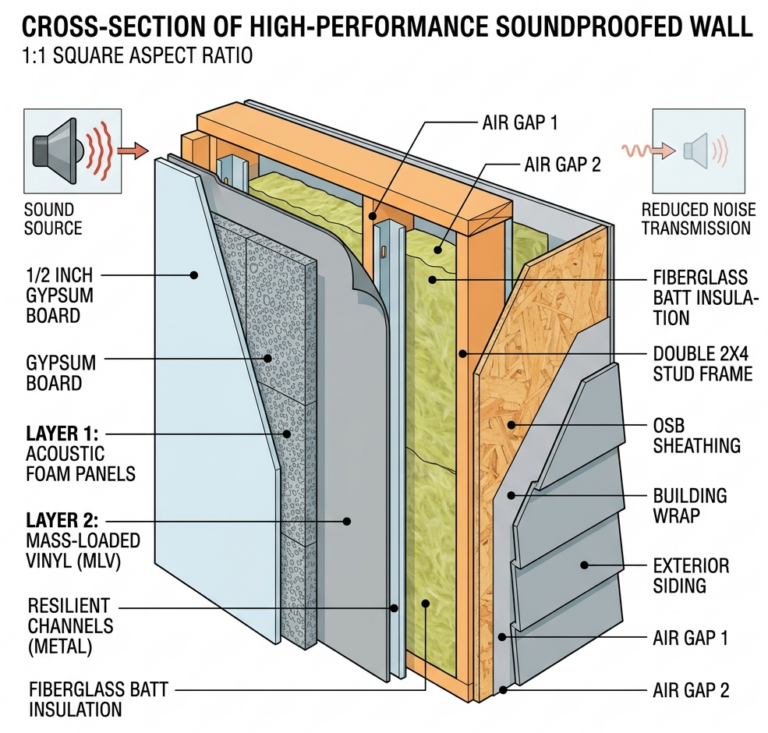
What Is Soundproofing? Understanding the Basics
Before diving into materials, it’s important to distinguish between two terms that are often confused:
- Soundproofing refers to blocking or reducing the transmission of sound from one space to another.
- Sound absorption refers to reducing echo and reverberation within a room.
True soundproofing addresses both — preventing sound from entering or leaving a room, while minimising the buildup of sound energy inside it. Effective sound proofing materials target one or both of these goals.
Sound travels as vibrations through air (airborne sound) and through solid materials (impact sound). The best soundproof solutions address both types.
The Four Core Principles of Soundproofing
Every soundproofing material works by applying one or more of these four fundamental principles:
1. Mass — Add Weight to Block Sound
Sound waves lose energy when they encounter heavy, dense barriers. This is why thick concrete walls are quieter than thin drywall. The greater the mass, the harder it is for sound waves to cause the material to vibrate and transmit noise to the other side.
Key sound proofing materials for mass:
- Mass Loaded Vinyl (MLV)
- Dense drywall (e.g. double-layer 5/8″ drywall)
- Concrete and brick
- Soundproof curtains with weighted linings
2. Decoupling — Break the Sound’s Physical Path
Sound travels efficiently through solid, connected structures. Decoupling means separating structural elements so vibrations cannot pass directly from one surface to another.
Imagine two walls built back-to-back with an air gap between them — sound hitting the outer wall cannot easily transfer to the inner wall because the physical connection is broken.
Key soundproofing materials and methods for decoupling:
- Resilient channels and sound isolation clips
- Double-stud wall construction
- Floating floors and ceiling systems
- Anti-vibration mounts
3. Absorption — Soak Up Sound Energy
Absorptive soundproofing materials convert sound wave energy into heat through friction as the sound passes through their fibrous or porous structure. This reduces reflections and reverb within a room and helps limit how much sound energy builds up.
Key sound proofing materials for absorption:
- Acoustic foam panels
- Fiberglass insulation (Rockwool / mineral wool)
- Acoustic ceiling tiles
- Thick carpets and rugs
- Upholstered furniture and heavy curtains
4. Damping — Dissipate Vibration Energy
Damping uses viscoelastic compounds to convert vibrational energy (in walls, floors, and ceilings) into heat. These materials are applied between rigid surfaces to reduce resonance — the tendency of materials to vibrate and amplify certain sound frequencies.
Key soundproofing materials for damping:
- Green Glue Noiseproofing Compound
- Damping adhesives and sprays
- Constrained Layer Damping (CLD) panels
A Guide to the Most Effective Soundproofing Materials
Mass Loaded Vinyl (MLV)
One of the most versatile and effective sound proofing materials available, MLV is a heavy, flexible sheet material that adds significant mass to walls, floors, and ceilings without major construction work. It can be layered behind drywall, under flooring, or hung as a barrier.
Best for: Apartment walls, home studios, under-floor soundproofing
Acoustic Foam Panels
Acoustic foam is the most recognisable soundproofing material — those familiar wedge or egg-crate tiles seen in recording studios. However, it’s important to understand that acoustic foam primarily absorbs sound within a room (reducing echo and reverb) rather than blocking sound from passing through walls.
Best for: Home recording studios, podcasting rooms, home theatres
Rockwool / Mineral Wool Insulation
Rockwool (also known as mineral wool or stone wool) is a dense, fibrous insulation material that excels at both thermal and acoustic performance. When installed inside wall cavities, it significantly reduces airborne sound transmission.
Best for: Inside walls and ceilings during construction or renovation
Green Glue Noiseproofing Compound
Green Glue is a viscoelastic damping compound applied between two rigid layers (such as drywall panels). As the layers flex under sound pressure, the Green Glue dissipates that energy as heat. It is one of the most cost-effective soundproofing upgrades during drywall installation.
Best for: New drywall installation, wall and ceiling renovation projects
Resilient Channels and Isolation Clips
These metal channels and rubber-padded clips are mounted to studs or joists before drywall is attached. They decouple the drywall from the structure, preventing vibrations from travelling through the building frame.
Best for: Ceilings in multi-storey buildings, shared walls in apartments
Soundproof Curtains and Acoustic Blankets
While not a replacement for structural soundproofing, heavy soundproof curtains and moving blankets can provide a meaningful reduction in noise, especially for windows — a common weak point in any soundproof strategy.
Best for: Temporary soundproofing, rental properties, windows and doorways
Weatherstripping and Door Seals
Sound, like air, travels through gaps. A solid-core door with poor seals will leak far more sound than a lighter door that is properly sealed. Door sweeps, acoustic gaskets, and weatherstripping are inexpensive but highly effective sound proofing materials for entry points.
Best for: Doors, window frames, cable and pipe penetrations
How to Choose the Right Soundproofing Materials for Your Situation
Choosing the right soundproofing approach depends on your specific noise problem. Here’s a quick guide:
| Noise Problem | Recommended Approach |
|---|---|
| Noisy neighbours through shared wall | Mass (MLV + double drywall) + Decoupling (resilient channels) + Damping (Green Glue) |
| Footsteps from upstairs | Decoupling (floating floor) + Mass (MLV underlay) |
| Echo and reverb in a room | Absorption (acoustic foam, Rockwool panels, rugs) |
| Street noise through windows | Soundproof curtains + secondary glazing + weatherstripping |
| Home recording studio | Full MADD approach: Mass + Absorption + Decoupling + Damping |
| Noisy home office | Acoustic panels + door seals + soundproof curtains |
Common Soundproofing Myths — Debunked
Myth 1: Acoustic foam will soundproof a room. Acoustic foam absorbs sound reflections inside a room but does very little to stop sound from passing through walls. For true soundproofing, you need mass, decoupling, and damping.
Myth 2: Egg cartons work as sound proofing materials. Egg cartons have negligible mass and poor absorption properties. They are not effective soundproofing materials and are a fire hazard.
Myth 3: You need to completely gut a room to soundproof it. While major renovations yield the best results, significant improvements can be made with surface-applied sound proofing materials like MLV, acoustic panels, soundproof curtains, and door seals — without demolition.
Myth 4: Soundproofing and sound absorption are the same thing. As covered above, soundproofing blocks sound transmission, while sound absorption reduces echo within a space. Most effective solutions combine both.
Final Thoughts — The Best Soundproofing Strategy Is a Layered One
No single soundproofing material works in isolation. The most effective soundproof results come from combining the four principles: Mass, Absorption, Decoupling, and Damping — sometimes called the MADD approach.
Whether you’re soundproofing a bedroom, a home studio, a home office, or an entire apartment, understanding how these sound proofing materials work allows you to build a targeted, cost-effective strategy rather than guessing and wasting money on solutions that won’t perform.
Start with your biggest noise source, identify whether it’s airborne or impact sound, and layer your materials accordingly. With the right soundproofing materials in place, genuine quiet is achievable.
