
Before You Build a Home Cinema: Everything You Need to Know (2026 Guide)
You’ve dreamed about it. A dedicated space in your home where the outside world disappears, the screen dominates your vision, and every seat feels like the best seat in the house. But before you knock down a wall or drop a deposit on a projector, there are critical decisions — and costly mistakes — that every aspiring home cinema owner needs to understand.
This guide covers everything: from planning your home cinema room to choosing between budget and luxury home cinema setups — so you build it right the first time.
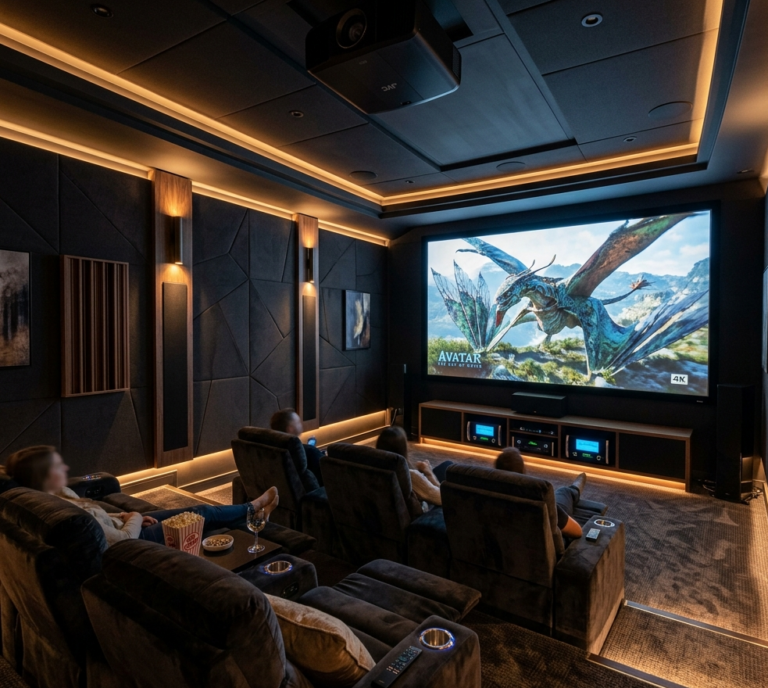
Why Home Cinemas Are No Longer Just for the Ultra-Wealthy
Not long ago, a private home cinema was the exclusive domain of Hollywood producers and tech billionaires. That’s changed. Advances in display technology, audio engineering, and smart home integration have made high-quality home cinema solutions accessible to a much wider audience.
Whether you’re transforming a spare bedroom, converting a basement, or designing a bespoke dedicated suite, the entry point for a genuinely impressive home cinema setup has dropped dramatically — while the ceiling for what’s possible has risen just as dramatically.
But accessibility doesn’t mean simplicity. There’s still a vast difference between a room with a big TV and a proper home cinema room engineered for immersive performance.
Why Home Cinemas Are No Longer Just for the Ultra-Wealthy
Not long ago, a private home cinema was the exclusive domain of Hollywood producers and tech billionaires. That’s changed. Advances in display technology, audio engineering, and smart home integration have made high-quality home cinema solutions accessible to a much wider audience.
Whether you’re transforming a spare bedroom, converting a basement, or designing a bespoke dedicated suite, the entry point for a genuinely impressive home cinema setup has dropped dramatically — while the ceiling for what’s possible has risen just as dramatically.
But accessibility doesn’t mean simplicity. There’s still a vast difference between a room with a big TV and a proper home cinema room engineered for immersive performance.
Step 1: Define Your Vision
Before a single cable is run or a screen is mounted, ask yourself one question: what do you actually want from your home cinema?
Your answer will determine everything else.
- Casual viewing upgrade — A large 4K screen, a soundbar, and decent seating. Functional and affordable, but this is not really a home cinema — it’s a living room with ambition.
- Dedicated home cinema room — A purpose-built or converted space with a projector, surround sound, acoustic treatment, and controlled lighting. This is where the experience begins.
- Private home cinema setup — A fully isolated, professionally designed room with calibrated audio, cinema-grade projection, motorised seating, and smart automation. The gold standard for serious enthusiasts.
- Luxury home cinema setup — Custom architectural design, handcrafted interiors, 4K laser projection, Dolby Atmos or Auro-3D sound, bespoke cabinetry, and integrated smart home systems. This is a lifestyle statement as much as an entertainment space
Step 2: Choose the Right Room
The single most important factor in any home cinema room isn’t the screen size or the speaker brand. It’s the room itself.
Room Shape and Size
Rectangular rooms are the most acoustically predictable and the easiest to design around. Square rooms are notoriously difficult for audio due to standing wave issues. For a proper private home cinema, most designers recommend a room with a length-to-width ratio of approximately 1.6:1, with ceiling height of at least 2.7 metres (ideally 3m+).
For seating up to 6–8 guests comfortably, a room of approximately 5m x 7m is considered a practical minimum. Luxury home cinema spaces often run from 6m x 9m upward.
Light Control
A dedicated home cinema demands complete darkness. North-facing rooms or interior rooms (basements, converted garages) are ideal because they minimise natural light intrusion. If your chosen room has windows, high-quality blackout systems — motorised blinds, blackout shutters, or custom-built window treatments — are non-negotiable.
Noise Isolation
Two things matter here: keeping outside noise out, and keeping your cinema’s sound in. Without proper acoustic isolation, bass frequencies bleed into adjacent rooms and external sounds destroy immersion. This is where serious home cinema solutions diverge from amateur builds — professional acoustic isolation is built into the structure, not bolted on afterward.
Step 3: Get the Acoustics Right (Before Anything Else)
Ask any professional AV designer what separates a good home cinema room from a great one, and the answer is always the same: acoustics.
The room is the most powerful audio component in any home cinema setup. Hard parallel walls cause flutter echo. Low ceilings compress bass response. Untreated rooms create muddy, fatiguing sound regardless of how expensive your speakers are.
Acoustic Treatment Essentials
Bass traps belong in every corner, particularly the floor-ceiling corners, to tame low-frequency buildup. Broadband absorbers control mid and high-frequency reflections on the front wall, rear wall, and side walls. Diffusers scatter sound energy to add life and spaciousness without killing all reverb.
For luxury home cinema setups, acoustic treatment is integrated into the architecture itself — purpose-built stud walls with mass-loaded vinyl, decoupled floating floors, and custom fabric-wrapped panels that double as interior design features.
Acoustic Design Is Not DIY Territory
For anything beyond a casual home cinema upgrade, acoustic design should be handled by a specialist. Getting the mathematics of room modes, reflection points, and speaker placement wrong is far more expensive to fix after construction than to do correctly from the outset.
Step 4: Display Technology — Projector or Screen?
This is where most people start — and it shouldn’t be. But once your room and acoustics are planned, choosing your display becomes much clearer.
Projectors
A high-quality projector delivers the most cinematic experience of any home cinema setup. For dedicated dark rooms, 4K laser projectors — from manufacturers such as Sony, JVC, and Barco — produce exceptional image quality with deep blacks, wide colour gamut, and screen sizes from 100–200+ inches.
Luxury home cinema setups typically feature 4K laser projectors with HDR support and high native contrast ratios. Expect to invest £5,000–£50,000+ for genuinely reference-grade projection.
Large-Format Screens (LED and OLED)
Premium direct-view displays — including Sony BRAVIA Theatre systems, Samsung The Wall, and LG OLED panels — offer stunning brightness and contrast for private home cinema environments where full light control isn’t possible. Some luxury home cinema installations pair both: a projector for film viewing and a large OLED for gaming or sports.
Screens Matter Too
For projection-based home cinema rooms, the screen is not passive. Acoustically transparent screens allow speakers to be positioned behind the screen (as in a real cinema), dramatically improving dialogue intelligibility. Gain, texture, and frame type all affect the final image.
Step 5: Sound — The Heartbeat of Every Home Cinema
If the room is the body of your home cinema and the screen is its face, the sound system is its heartbeat. And here, the difference between a good and a great home cinema setup is immediately felt.
Surround Sound Formats
- Dolby Atmos — The industry standard for object-based 3D audio, placing sound in precise three-dimensional positions including overhead. Essential for any serious private home cinema setup.
- DTS:X — A competitor to Atmos with similar object-based capabilities, supported by a wide range of hardware.
- Auro-3D — A height-channel format favoured by some audiophiles for its natural, immersive quality. Popular in luxury home cinema installations.
A proper Dolby Atmos home cinema typically runs a 7.1.4 or 9.1.4 speaker configuration — seven surround channels, one subwoofer, and four height channels.
Amplification and Processing
Separating the amplifier from the processor (using a dedicated AV processor and power amplifiers) delivers significantly superior performance to all-in-one AV receivers. This approach is standard in luxury home cinema setups and makes a meaningful audible difference, particularly at higher listening levels.
Subwoofers
Cinema bass is a physical experience. Two or more subwoofers, carefully positioned using the distributed bass array principle, deliver even bass response throughout the entire home cinema room rather than creating hot spots and dead spots.
Step 6: Seating — Where Comfort and Cinema Meet
The finest luxury home cinema setup in the world is diminished by uncomfortable seating. And yet seating is often the last thing people plan.
Dedicated home cinema seating comes in several forms:
- Home cinema recliners — Motorised luxury recliners with integrated headrests, lumbar support, cup holders, and USB charging are the standard choice for private home cinema setups. Brands including Fortress, Moovia, and Cineak produce bespoke cinema seating used in the finest installations worldwide.
- Tiered platforms — Two or three rows of seating on raised platforms ensures unobstructed sightlines for every viewer. Essential for rooms accommodating more than a single row.
- Row spacing — Allow a minimum of 1.2 metres between rows (front-edge of back row to back-edge of front row) for comfortable reclining clearance.
In luxury home cinema designs, seating is often fully bespoke — upholstered in premium leather or mohair, specified to match the room’s design language, with integrated ambient lighting at the base.
Common Mistakes to Avoid
Even well-intentioned home cinema builds go wrong. Here are the most common and costly errors:
- Skipping acoustic treatment — The number one regret of DIY builds. Acoustics first, always.
- Undersizing the subwoofer — One small subwoofer in a large home cinema room produces weak, uneven bass. Plan for two.
- Ignoring ventilation — AV equipment generates significant heat. Without adequate ventilation in your equipment cabinet and the room itself, overheating becomes a serious issue.
- Wrong screen size for the room — Too large, and viewers in the front row experience eye strain and distortion. Too small, and the sense of cinematic scale is lost. The Society of Motion Picture and Television Engineers (SMPTE) recommends a horizontal viewing angle of approximately 30–40 degrees for optimal immersion.
- Running cables after construction — All cable routes, conduit, and junction boxes must be specified and installed before plastering or finishing. Retrofitting cables through finished walls is enormously expensive.
- Choosing equipment before choosing a designer — For any serious home cinema setup, working with a specialist AV designer from day one ensures every component is specified and positioned correctly.
Common Mistakes to Avoid
Even well-intentioned home cinema builds go wrong. Here are the most common and costly errors:
- Skipping acoustic treatment — The number one regret of DIY builds. Acoustics first, always.
- Undersizing the subwoofer — One small subwoofer in a large home cinema room produces weak, uneven bass. Plan for two.
- Ignoring ventilation — AV equipment generates significant heat. Without adequate ventilation in your equipment cabinet and the room itself, overheating becomes a serious issue.
- Wrong screen size for the room — Too large, and viewers in the front row experience eye strain and distortion. Too small, and the sense of cinematic scale is lost. The Society of Motion Picture and Television Engineers (SMPTE) recommends a horizontal viewing angle of approximately 30–40 degrees for optimal immersion.
- Running cables after construction — All cable routes, conduit, and junction boxes must be specified and installed before plastering or finishing. Retrofitting cables through finished walls is enormously expensive.
- Choosing equipment before choosing a designer — For any serious home cinema setup, working with a specialist AV designer from day one ensures every component is specified and positioned correctly.
The Investment Case for a Home Cinema
A well-executed private home cinema setup or luxury home cinema adds demonstrable value to a property — particularly at the top end of the market where buyers expect premium lifestyle spaces. Beyond financial value, the lifestyle return is immediate: every evening at home becomes an event. Film, sport, gaming, and music all benefit.
The key is doing it properly. A beautifully designed and engineered home cinema will bring decades of pleasure. A poorly planned one — acoustically untreated, wrongly proportioned, or inadequately specified — will be a source of frustration from the first time the credits roll.
Ready to Begin?
Whether you’re planning a modest dedicated home cinema room or a full-scale luxury home cinema setup, the principles are the same: plan the room first, get the acoustics right, invest in quality where it matters, and work with specialists who have delivered home cinema solutions to the standard you’re aiming for.
The best home cinema you’ll ever experience could be the one in your own home. You just have to build it right.
